

The rapid advancement of generative AI has fundamentally reshaped digital content production, replacing traditional manual editing pipelines with intelligent, prompt-driven systems capable of generating complex video sequences in minutes.
1. Pollo AI
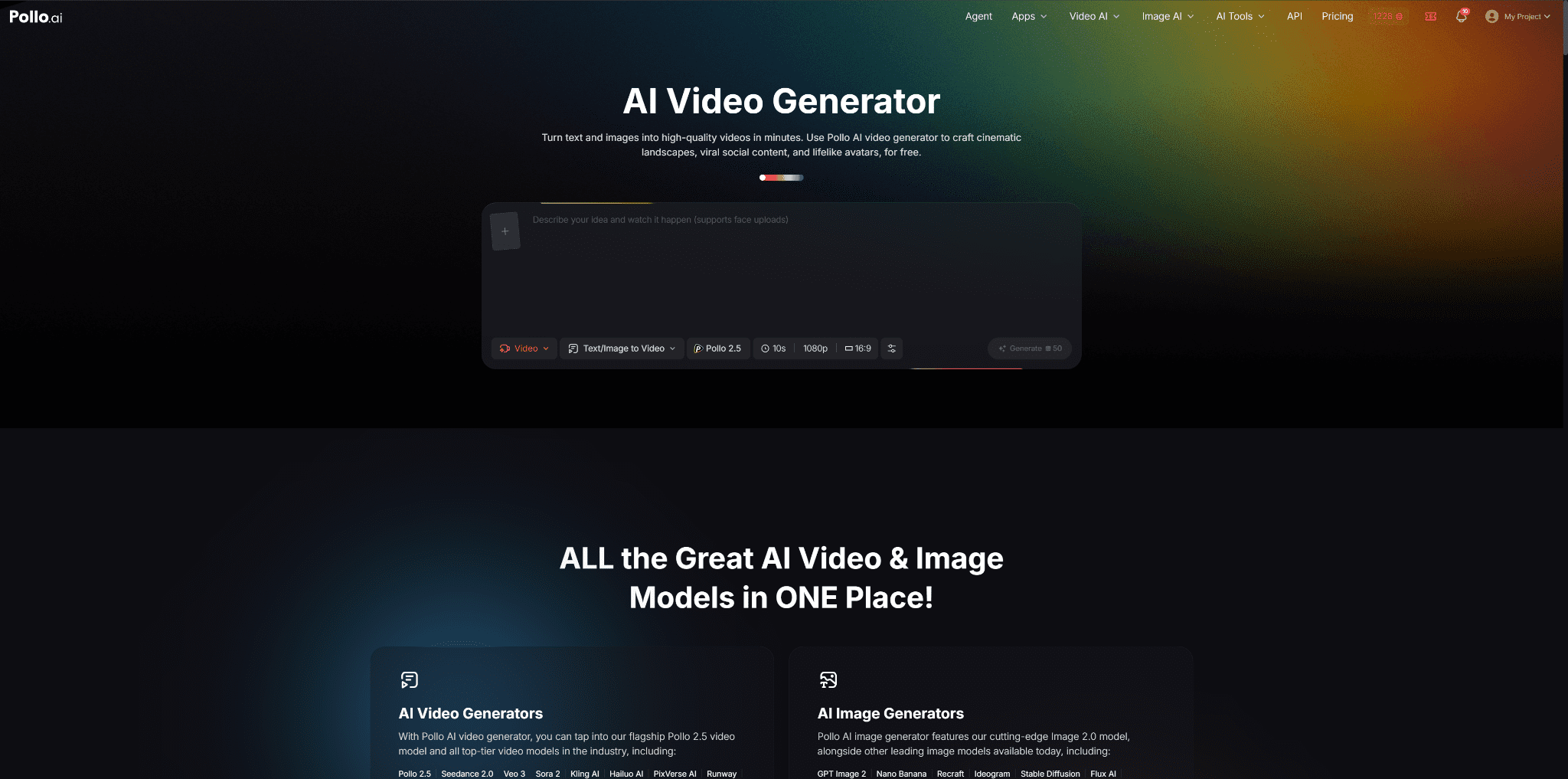
Pollo AI is positioned as a unified AI video maker that consolidates multiple models, creative applications, and production tools into a single integrated workspace. Rather than functioning as a single-purpose generator, it combines a wide range of generation capabilities including Text to Video AI, Image to Video AI, Video to Video AI, and Reference to Video workflows that ensure consistent character, object, and scene continuity across frames. It also includes advanced production utilities such as an AI Video Editor, AI Animation Generator, and AI Avatar Video Generator, enabling users to move seamlessly from concept development to final export within one environment. Beyond core generation tools, the platform provides a large ecosystem of specialized “Apps” tailored for different industries and creative objectives. These include marketing-focused formats like UGC Video Ads, Product Videos, Facebook Ad Videos, Testimonial Videos, and Clone Video Ads, as well as social and entertainment-oriented outputs such as Clone Viral Video, Celebrity Video, YouTube Outro Video, Faceless Video, and Dancing Girl Video. It further expands into cinematic and narrative production with Movie Trailer, B-Roll Video, Teaser Video, Music Video, Narrative Music Video, and Anime Video generation. Supporting all of this is access to multiple top-tier AI video models such as Pollo 2.5, Veo 3, Sora 2, Seedance 2.0, Kling AI, Runway, Luma AI, Pika AI, Vidu AI, Wan AI, and Hunyuan, allowing creators to switch between different generation engines depending on style, realism, and performance requirements.
Why It’s Worth Using

Pollo AI is particularly valuable because it transforms fragmented video production workflows into a streamlined, scalable, and highly efficient creative system. By combining model selection, generation tools, editing functions, and application-specific templates in one platform, it removes the need to constantly switch between separate software environments, which is a major bottleneck in modern content production pipelines. This makes it especially effective for marketing agencies, e-commerce brands, social media teams, and content studios that require consistent, high-volume video output across multiple channels and formats. Its extensive app ecosystem allows users to quickly produce targeted content such as UGC ads, product showcases, testimonial videos, promotional campaigns, and viral social media clips, as well as specialized formats like a YouTube outro maker, while maintaining strong visual consistency and brand alignment. At the same time, its support for cinematic outputs like trailers, narrative videos, and music videos ensures it can serve both commercial and creative production needs. Advanced features such as reference-to-video consistency, AI avatar generation, and automated editing tools significantly reduce manual workload while improving output quality. Overall, Pollo AI delivers a production-grade infrastructure that balances creative flexibility with operational efficiency, making it one of the most comprehensive AI video creation platforms available in 2026.

2. Runway (Gen-3 Alpha)
Runway Gen-3 Alpha is widely regarded as a cinematic-grade AI video maker that pushes the boundaries of visual fidelity and temporal consistency. It is built for high-end creative industries, including filmmaking, advertising, and visual effects production. The system is engineered to maintain stable frame-to-frame continuity, ensuring that fine visual details such as skin texture, fabric movement, and environmental lighting remain consistent throughout generated sequences. It supports advanced text-to-video and video-to-video workflows, allowing users to transform existing footage into stylized cinematic outputs. The platform also interprets professional filmmaking language, responding accurately to prompts involving lens types, depth of field, lighting setups, and camera movements. Its architecture is optimized for producing visually rich, realistic scenes that resemble professional studio-level production quality.
Why It’s Worth Using
Runway is worth using for creators who prioritize cinematic realism and professional storytelling standards. It is particularly effective for directors, advertisers, and visual artists who need precise control over mood, lighting, and composition. The platform’s advanced camera control system allows users to design complex motion paths such as crane shots, tracking shots, and dynamic angle shifts, making it suitable for film pre-visualization and commercial production. Additionally, its ability to maintain environmental consistency under motion makes it highly reliable for narrative-driven projects. While it requires more technical understanding of cinematography compared to simpler tools, the output quality justifies the learning curve. For users aiming to produce Hollywood-level visuals or high-end branded content, Runway remains one of the most powerful and industry-respected AI video maker solutions available.
3. Seedance 2.0
Seedance 2.0 is a precision-focused AI video maker designed to eliminate randomness in generative video creation. It introduces a structured, reference-driven generation system where text prompts and visual inputs act as strict guiding anchors rather than loose suggestions. This allows the model to maintain strong character consistency across frames, preserving facial identity, clothing details, and environmental continuity throughout a sequence. The platform is particularly strong in handling structured animations and controlled motion design, making it suitable for creators who require strict adherence to predefined visual plans. It also includes a fast rendering mode that enables rapid low-resolution previews, helping users test scene composition and motion logic before committing to full-quality output. Its architecture emphasizes stability, predictability, and repeatability in generative workflows.
Why It’s Worth Using
Seedance 2.0 is especially valuable for projects that require consistent character-driven storytelling or strict visual continuity. It is widely used in animation production, serialized content creation, and storyboard development where accuracy is more important than artistic randomness. The platform excels in scenarios involving repeated characters, multi-scene narratives, and structured motion sequences. Its physics-aware rendering system ensures realistic movement of objects, fabrics, and environmental effects, making outputs feel grounded and coherent. For studios and independent creators, its fast preview mode significantly reduces iteration time, enabling faster decision-making in production pipelines. Overall, Seedance 2.0 is ideal for professionals who prioritize control, stability, and repeatable results over experimental or highly abstract generation styles.
4. Pika AI
Pika AI is a creatively oriented AI video maker that focuses on stylized, expressive, and highly customizable video generation. It is designed for users who prioritize artistic freedom over strict photorealism, making it especially popular among social media creators, animators, and digital storytellers. The platform supports text-to-video and image animation workflows, enabling users to transform static visuals into dynamic motion sequences. One of its key features is object-level motion control, which allows users to define movement paths for specific elements within a scene. It also includes inpainting and outpainting tools for localized editing, enabling precise adjustments without regenerating entire videos. Additionally, its system can generate audio elements that match visual motion, creating synchronized audiovisual outputs for short-form content creation.
Why It’s Worth Using
Pika AI stands out for its accessibility and speed, making it highly suitable for fast-paced content production environments. It is particularly effective for TikTok creators, YouTubers, and marketing teams producing short-form promotional videos. Its intuitive interface allows users to experiment with motion design without requiring advanced technical knowledge. The ability to modify specific regions of a video makes iterative editing extremely efficient, saving both time and computational resources. Pika is also strong in producing visually engaging animated content, making it ideal for stylized storytelling, meme content, and experimental visuals. Its combination of motion control, audio synchronization, and quick rendering makes it one of the most flexible AI video maker tools for creators who value creativity, speed, and ease of use.
5. Luma AI
Luma AI, powered by its Dream Machine engine, is a physics-aware AI video maker designed to simulate realistic motion and environmental behavior. It is built on advanced neural rendering and 3D reconstruction technology, enabling it to generate videos with strong spatial consistency and realistic physics interactions. The system handles complex motion scenarios such as flowing liquids, moving vehicles, and dynamic crowd behavior with impressive stability. It also maintains consistent lighting and object proportions during camera movement, ensuring that scenes remain visually coherent from multiple angles. Its prompt system is optimized for rapid scene generation, allowing users to quickly convert textual descriptions into fully realized animated sequences with smooth camera transitions and stable object rendering.
Why It’s Worth Using
Luma AI is particularly valuable for creators who need realistic motion simulation and fast conceptual visualization. It is widely used in game development, visual effects planning, and early-stage film production where rapid prototyping is essential. The platform excels at maintaining structural integrity during complex motion, making it reliable for scenes involving fast movement or dynamic environmental changes. Its fluid camera system creates natural-looking cinematic motion without jitter or distortion, which enhances the realism of generated outputs. For professionals who need to quickly visualize action sequences or environmental concepts, Luma AI offers a highly efficient solution. Its balance of speed, realism, and spatial consistency makes it one of the most practical AI video maker tools for physics-driven content generation.
Conclusion
The current generation of AI video maker platforms demonstrates a clear shift toward specialized creative ecosystems rather than one-size-fits-all solutions. Pollo AI focuses on workflow unification and multi-model flexibility, while Runway emphasizes cinematic precision and professional-grade visual fidelity. Seedance 2.0 prioritizes strict control and consistency, making it ideal for structured storytelling and animation pipelines. Pika AI leans toward creative freedom and fast, stylized content production, whereas Luma AI specializes in physics-based realism and spatial coherence. Together, these five platforms represent different philosophies of generative video production, each addressing distinct industry needs. As demand for scalable video content continues to grow, selecting the right AI video maker will depend on balancing creative control, output quality, and production efficiency across specific use cases and team requirements.